
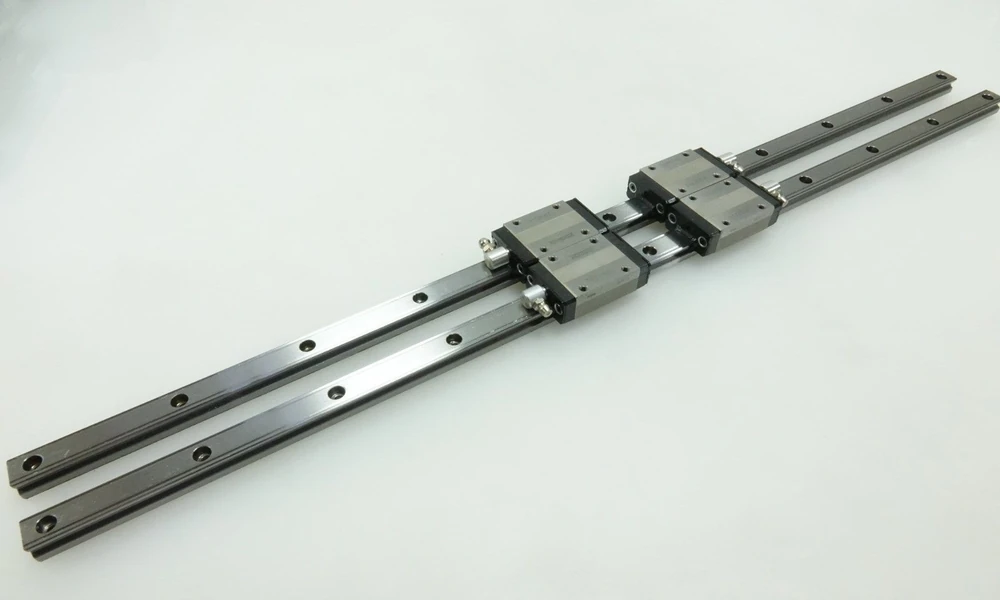

Industrial machinery operating at high speeds depends on more than motor power and sophisticated control systems. Stable, precise, and repeatable linear motion is equally important, particularly in CNC machines, automated production equipment, assembly systems, and material-handling applications where moving components repeatedly accelerate, stop, and change position.
The HSR series LM Guide bearing-a core product line manufactured by THK, a global leader in linear motion technology-is designed to support linear motion where load capacity, rigidity, and positioning accuracy matter. Its structure helps machine designers create motion systems that remain stable under varying loads while allowing the LM block to travel smoothly along the rail.
Here are five key characteristics that make the THK HSR series a practical option for demanding industrial machinery.
1. Supports Loads in Four Directions
One of the most important characteristics of the HSR series is its ability to support loads from multiple directions. This includes radial, reverse-radial, and lateral loads, allowing the LM Guide to accommodate forces generated from different directions during machine operation.
This capability is particularly useful in machinery where the moving assembly experiences changing loads. For example, a CNC machining center may encounter different forces as the cutting tool moves across multiple axes, while automated handling equipment may experience changes in load as a workpiece is picked up, moved, and released.
By providing balanced load support, the HSR configuration can also give machine designers greater flexibility in rail orientation and overall mechanical layout.
2. High Rigidity Helps Maintain Machine Stability
High-speed motion introduces forces that can affect positioning, especially during rapid acceleration and deceleration. If the guide mechanism lacks sufficient rigidity, even small amounts of displacement or vibration can influence machining accuracy and repeatability.
The HSR series is designed to provide high rigidity across the linear motion system, helping the rail and LM block maintain stable movement under load. Appropriate preload can also increase rigidity, provided that preload, load conditions, and installation requirements are properly calculated during machine design.
This characteristic makes the HSR series relevant to applications such as CNC machines, machine tools, automated assembly equipment, and production systems that repeatedly move between programmed positions.
3. Smooth Linear Motion Supports Positioning Accuracy
Precision is not simply about reaching the correct final position. The motion between positions must also remain smooth and predictable.
The HSR series uses recirculating balls between the LM block and rail, allowing the moving assembly to travel with low rolling resistance and smooth linear movement. Reduced resistance helps the drive system control movement more consistently compared with conventional sliding mechanisms that rely primarily on sliding contact.
For machines performing repetitive positioning, smoother movement can contribute to better control of acceleration, deceleration, and stopping points. This is especially valuable in CNC equipment, grinding machines, pick-and-place systems, precision assembly equipment, and automated production lines.
When evaluating a component for these applications, specifications for HSR LM Guide bearing should be considered together with the machine’s actual load, required accuracy, operating speed, rail configuration, and installation conditions.
4. Self-Adjustment Helps Accommodate Mounting Errors
Perfect alignment can be difficult to achieve in real-world machine assembly, particularly when two or more rails are installed on large machine frames. Small variations in mounting surfaces, rail alignment, or structural tolerances can create unwanted loads within the guide system.
An important feature of the HSR series is its self-adjustment capability, which can help accommodate a certain degree of mounting error. This gives designers and machine builders additional flexibility when assembling linear motion systems while supporting smooth, accurate travel.
However, self-adjustment should not be treated as a substitute for proper installation. Rail parallelism, mounting-surface accuracy, bolt tightening procedures, and manufacturer-specified tolerances still need to be followed to achieve the intended performance and service life.
5. Designed for Durability in Repetitive Industrial Motion
Many industrial machines operate for long production cycles and perform thousands of repeated movements. Under these conditions, premature wear in the linear motion components can lead to increasing positioning errors, maintenance requirements, and unplanned machine downtime.
The HSR series is designed to support repetitive linear movement while maintaining accuracy over extended operation. Its recirculating-ball structure allows loads to be distributed through the rolling elements while supporting consistent motion under appropriate operating conditions.
Durability, however, depends on more than the guide itself. Correct sizing, lubrication, sealing, contamination control, preload, mounting accuracy, and operating environment all influence the actual service life of an LM Guide. A guide that is undersized or inadequately lubricated may wear prematurely even when the product is designed for demanding industrial applications.
What Types of Machinery Can Use the HSR Series LM Guide Bearing?
Because of its combination of load capacity, rigidity, smooth movement, and positioning capability, the HSR series LM Guide bearing can be considered for a broad range of industrial systems, including:
– CNC machines and machine tools
– Automated production machinery
– Component assembly equipment
– Pick-and-place systems
– Semiconductor manufacturing equipment
– Material-handling and transfer systems
– Precision positioning equipment
– Industrial automation systems requiring linear motion
The correct HSR model should not be selected solely by rail size. Engineers should also evaluate dynamic and static loads, moment loads, travel speed, stroke length, operating frequency, required precision, preload, lubrication, and environmental conditions.
For high-cycle machinery, these factors become even more important because small errors in sizing or installation can become increasingly significant after prolonged operation.
Conclusion
The HSR series LM Guide bearing (ตลับลูกปืน LM Guide HSR) offers several characteristics that support demanding linear motion applications: four-direction load capacity, high rigidity, smooth and precise movement, self-adjustment capability, and durability under repetitive operation.
For high-speed machinery, these advantages can help create a more stable motion system, but achieving reliable long-term performance still requires proper model selection, installation, lubrication, and maintenance. Matching the LM Guide to actual machine conditions is therefore an essential part of designing an efficient linear motion system.
For manufacturers or machine builders that need assistance selecting THK linear motion components, I.N.B. Enterprise is an authorized distributor of THK products in Thailand with more than 30 years of experience serving industrial customers nationwide. The company provides product consultation to help solve application-related issues, supports machine design and component selection, and offers on-site measurement services at no additional charge, helping engineers evaluate the appropriate solution for their machinery and operating requirements.


