
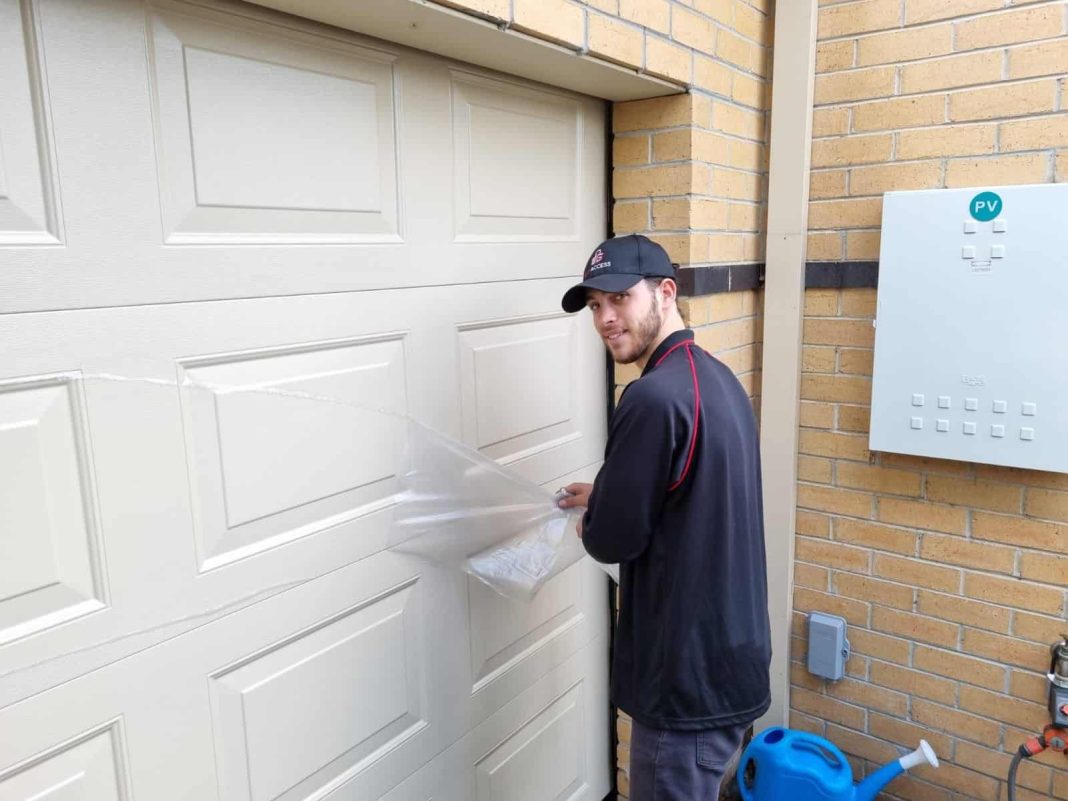

A garage door is a counterbalanced mechanical system driven by torsion, cables, rollers, tracks, and an operator. When something breaks, it’s rarely an isolated failure. One bad part creates stress that spreads through the entire system. If you don’t understand how the door’s load is distributed, you’ll misdiagnose the problem—leading to repeat failures, premature wear, or unsafe operation. An in-depth breakdown is the only way to understand what’s actually happening when things go wrong.
1. Torsion Spring Failures
Why Springs Fail
Torsion springs absorb and release massive amounts of stored energy every time the door cycles. Metal fatigues. Cycle ratings get burned through. Rust accelerates wear. When a spring finally snaps, it doesn’t ease down—it explodes. After that, the door becomes dead weight.
What Actually Happens Mechanically
- The lifting force drops to zero.
- Cables lose balance and may loosen or jump the drum.
- The operator tries to compensate, burns out, or strips internal gears.
The Correct Fix
- Replace all springs in a matched pair.
- Recalculate lift to ensure correct wire gauge and coil count.
- Rebalance the entire door manually before reconnecting the opener.
Half-fixes here are useless. Spring imbalance destroys everything downstream.
2. Cable Problems
Why Cables Get Damaged
Cables fray from metal fatigue, contamination, bad tensioning, or misaligned drums. Once a cable stretches or wears unevenly, the door pulls to one side and becomes unstable.
What You’ll See
- Door lifting unevenly
- Cable hanging loose
- Grinding or scraping noises
- Rapid jerking when the door moves
The Correct Fix
- Replace both cables with the correct diameter and length.
- Inspect bearings and drum surfaces for scoring.
- Reset torsion tension and confirm drum alignment.
If you skip the tension check, the cables will slip again.
3. Roller and Track Issues
Why These Fail
Rollers carry enormous lateral and vertical loads. Tracks are only stable when perfectly aligned. Misalignment or worn rollers create resistance the operator isn’t designed to handle.
Mechanical Symptoms
- Slow, noisy travel
- Vibration through the entire door
- Door drifting out of its tracks
- Early motor burnout
The Correct Fix
- Replace worn rollers (steel for load, nylon for noise reduction).
- Realign tracks so they are parallel, plumb, and properly spaced.
- Identify frame distortion or sagging headers that caused the misalignment.
Track issues are structural—not cosmetic.
4. Sensor and Safety System Failures
Why Sensors Act Up
Sensors aren’t complicated—yet they cause constant problems. Dirt, misalignment, wire damage, or failing logic boards all trigger random reversing or refusal to close.
What You See
- Door starts down and reverses immediately
- Opener lights blinking
- Intermittent closing failures
The Correct Fix
- Realign sensors precisely; even 2–3 millimeters can break the beam.
- Replace damaged wiring instead of patching it.
- Test and recalibrate reversal force and travel limits.
Skipping calibration is the reason most “fixed” sensors fail again.
5. Operator and Electronics Failures
Why Operators Break
Motors don’t just “decide to stop working.” Something upstream stresses them: bad balance, worn gears, overheating, or corrupted limit settings.
What You’ll Notice
- Opener hums but won’t lift
- Stops mid-cycle
- Refuses to open under load
- Repeated overheating shutoffs
The Correct Fix
- Diagnose balance first—never start with the motor.
- Inspect internal sprockets, gears, and capacitors.
- Reset limit settings from scratch.
- Replace logic boards when troubleshooting points to electrical failure.
Fixing a motor without checking balance guarantees another failure.
6. Panel Damage and Structural Distortion
The Real Problem
Panel damage is rarely superficial. When a panel bends or bows, tension, hinge angles, track geometry, and stress points all shift. That change cascades into friction, misalignment, and eventual hardware failure.
The Correct Fix
- Replace the damaged panel if the structure is intact.
- Replace the full door if distortion affects alignment or load distribution.
- Reinforce hinges and brackets at stress points.
Trying to “bend it back” is amateur-level and short-lived.
7. Hardware Loosening and Fatigue
Why It Happens
Hinges, brackets, and fasteners loosen as metal expands and contracts under load. If you ignore these changes, components fracture.
The Correct Fix
- Tighten all fasteners and replace fatigued hardware.
- Inspect hinge knuckles for cracks.
- Confirm the screws are anchored in solid wood or structural framing.
Loose hardware indicates deeper mechanical imbalance—not just wear.
When a Professional Is Non-Negotiable
Trying to fix springs, cables, or operator load issues without training is reckless. You need someone who diagnoses systemic faults—not just symptoms. That’s why many rely on seasoned technicians experienced in full-system solutions such as Door Doctor garage door repair, because the real fix is identifying the root mechanical cause, not just replacing the part that failed.
Bottom Line
Garage door failures are predictable: spring breakdowns, cable issues, roller wear, track distortion, sensor faults, and operator burnout. Each symptom points to a deeper mechanical imbalance. Fixing the root cause—not the surface problem—is what restores long-term reliability.


